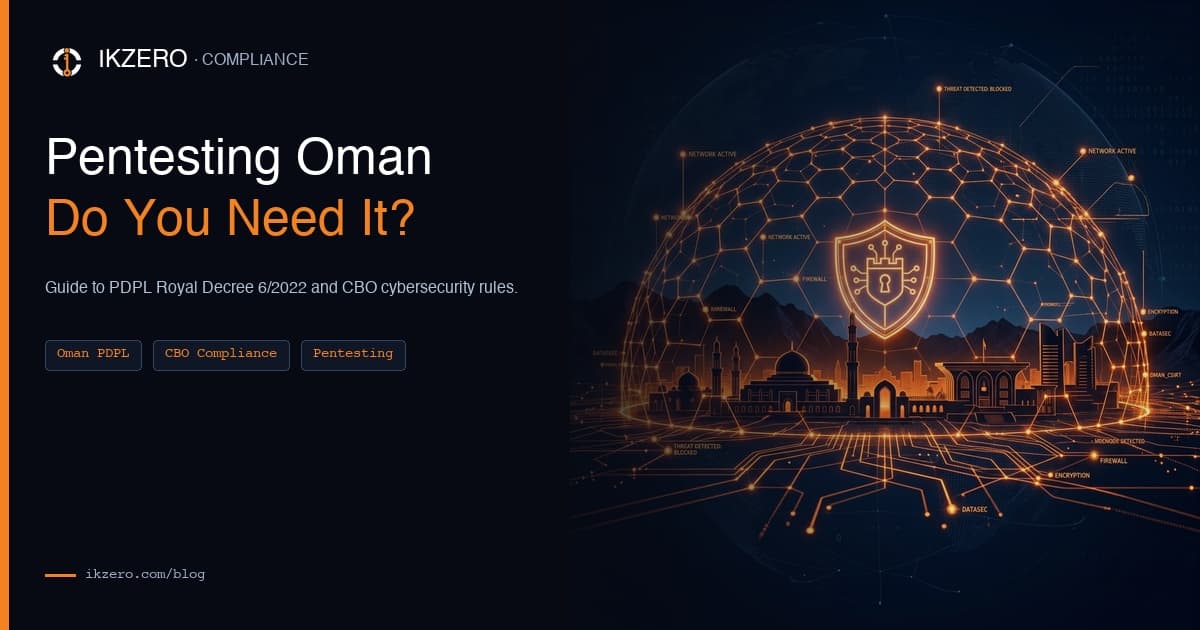
If your Omani business holds personal data, processes online payments, or runs any internet-facing system, penetration testing is one of the smartest security investments you can make. Personal data security sits at the heart of Oman's Personal Data Protection Law (PDPL, Royal Decree 6/2022), and banks and fintechs also work to the Central Bank of Oman (CBO) Cyber Security and Resilience Framework. A penetration test is the most direct way to prove those systems actually hold up against a real attacker.
What is a penetration test?
A penetration test (or "pentest") is an authorised, simulated cyberattack against your own systems, carried out by security specialists to find exploitable weaknesses before criminals do. Unlike an automated vulnerability scan, which lists potential issues, a pentest attempts to actually exploit them, chaining flaws together the way a genuine attacker would and showing what data or access could be compromised.
Common scopes include external network and infrastructure, web and mobile applications, internal networks, cloud environments, and social-engineering tests such as phishing. The deliverable is a report ranking each finding by severity with clear remediation steps, so your team knows what to fix first.
Penetration testing and Oman's PDPL
Oman's PDPL centres on protecting personal data with appropriate security measures, and penetration testing is the standard way to demonstrate that those measures actually work. The law was issued as Royal Decree 6/2022, with Executive Regulations under Ministerial Decision 34/2024, and sits within the remit of the Ministry of Transport, Communications and Information Technology (MTCIT).
Good data-protection practice means putting real controls and procedures in place to protect personal data, and being able to show they hold up under pressure. Regular penetration testing is one of the clearest ways to evidence a strong, proactive security posture, finding and fixing weaknesses before an attacker reaches them.
What does the Central Bank of Oman (CBO) expect?
If you are a bank, financing or leasing company, payment service provider, or money exchange company, the CBO's Cyber Security and Resilience Framework (CS&RF), issued in 2023, sets minimum cybersecurity requirements that go well beyond the PDPL. The framework is organised into six control domains: Governance, Compliance and Audit, Technology and Operations, Third-Party Supply Chain Management, Online Financial Services, and Risk Management.
Regulated financial institutions and licensed fintechs are expected to run continuous monitoring, strong technology controls, and regular security testing of the kind pentesting provides, particularly for online financial services and customer-facing platforms. If you operate in Oman's financial sector, treat regular penetration testing as an operational expectation, not an optional extra.
Who else in Oman should run a pentest?
Beyond regulated finance, penetration testing is strongly advisable for any organisation that would suffer real harm from a breach. That includes:
- E-commerce and retail handling card data or large customer databases.
- Healthcare and clinics holding sensitive medical records (a special category under the PDPL).
- Government suppliers and critical infrastructure, where Oman's National Computer Emergency Readiness Team (OCERT), part of the national cybersecurity structure, coordinates incident response and issues technical guidance.
- SaaS and technology firms whose product security is central to customer trust.
- Any business with a customer login, payment page, or internet-facing application.
If a successful attack would expose personal data, damage customer trust, or halt operations, the cost of a pentest is small against that exposure. A secure foundation starts at build time, which is why we treat security as part of web development for Oman rather than a bolt-on afterwards.
When should you run a penetration test?
There is no single fixed frequency, but industry practice and the direction of Oman's regulations point to a clear rhythm. Run a penetration test:
- At least annually for systems holding personal or financial data.
- After significant changes, such as a new application, major feature, infrastructure migration, or cloud move.
- Before launching a customer-facing platform, payment flow, or mobile app.
- When a regulator, partner, or enterprise client asks for evidence of your security posture.
- After a security incident, to confirm the root cause is fixed and no further footholds remain.
Between full tests, pair pentesting with continuous vulnerability scanning so newly introduced weaknesses do not sit unnoticed for months.
Web application penetration testing in Oman: what actually gets checked
Most Omani businesses start with their website or web app, and for good reason. Oman's digital economy is targeted to reach 10% of GDP by 2040 under Oman Vision 2040, and more of that trade runs through websites every year. A weak checkout page, customer account area or admin panel now puts real revenue and real customer trust on the line.
In a web application test, the tester works through the parts of your site where money and personal data move:
- Login and session handling: can someone stay signed in as another user, or reset a password they should not control?
- User roles and permissions: can an ordinary customer reach admin screens, or open somebody else's order?
- Input handling: what happens when a form field is fed something malicious instead of a name or an address?
- APIs: the endpoints your website and mobile app talk to, which are often less protected than the site itself.
- Payment flows: can a price, a quantity or an order total be changed on the way through?
- File uploads: can somebody upload a script instead of a photo or a PDF?
- The database connection: how much of your data is reachable once a single flaw is found.
The output tells you what an attacker could actually walk away with: customer records, admin access, order data, or the ability to plant malware on your site.
How does the testing process work?
A professional engagement runs in four clear stages:
- Scoping. You and the tester agree what is in scope (which domains, apps, APIs and environments) plus the rules of engagement, timing and emergency contacts. Testing against a live system is scheduled to avoid disruption, and this is where the test type is fixed (see below).
- Mapping. The tester works out what your application is built on, where every entry point is, which user roles exist and how data moves between them. That is your attack surface.
- Exploitation. The tester actively tries to break the login, climb from an ordinary user up to an admin, feed the app malicious input, reach other users' data and get to the server underneath, proving each finding safely, with evidence.
- Reporting and retest. Findings are written up, rated and handed over. Once your team has fixed them, the tester goes back and checks the fixes actually hold.
The ten most common web attacks (OWASP Top 10)
Most testers work to a standard checklist called the OWASP Top 10 (2021), the ten problems that break real web applications most often:
- People reaching data they should not (broken access control): the most common issue by far, and the one behind most "how did they see another customer's order?" incidents.
- Weak or missing encryption (cryptographic failures): sensitive data left readable while it travels or while it sits in storage.
- Malicious input the app runs (injection): where a form field is treated as a command instead of text.
- Flaws built into the design (insecure design): problems in how the system was planned, not bugs in the code.
- Sloppy setup (security misconfiguration): default passwords, exposed admin panels, error pages that give too much away.
- Old, unpatched building blocks (vulnerable and outdated components): the plugins, libraries and frameworks nobody updated.
- Weak login handling (identification and authentication failures): guessable passwords, poor session handling, no limit on repeated attempts.
- Untrusted code and updates (software and data integrity failures): changes that reach production without being checked.
- No alarm bells (security logging and monitoring failures): the breach that runs for months because nothing was watching.
- Tricking your server into making requests (server-side request forgery, SSRF): using your own server to reach systems an outsider cannot.
Building this in from day one costs far less than retrofitting it later, which is why secure web development and periodic testing work best as a pair.
Black box, grey box or white box: which test do you need?
The three types differ by how much the tester is told up front:
- No-knowledge test (black box): no accounts, no documents, no source code. It mirrors an outsider starting from zero. Realistic, but a limited budget can be spent just finding the door.
- Part-knowledge test (grey box): the tester is given normal user accounts and some documentation. For most web apps this is the best value, because it goes straight to roles, permissions and the logged-in parts of the app where the real damage happens.
- Full-knowledge test (white box): full access to source code, architecture and credentials, for the deepest review possible.
For most Omani e-commerce and SaaS applications, a grey-box test gives the strongest balance of realism and coverage.
What you get at the end: the report
A good report is written for two very different readers at once.
The executive summary is for whoever signs off the budget: what the risk means for the business, in plain language, with an overall picture of where you stand and what to tackle first.
The technical section is for your developers. Each finding carries a severity rating (usually Critical down to Informational, often scored using the industry-standard CVSS system), a plain description, step-by-step instructions to reproduce it with evidence attached, the business impact, and specific advice on how to fix it.
It should close with a prioritised action plan, and, once your team has done the work, retest results confirming each fix really closed the gap.
How much does penetration testing cost in Oman?
Cost depends on scope, not a fixed price list, so treat any headline figure with caution. The main drivers are the number and complexity of targets (a single web app versus a full external, internal and cloud estate), the depth of testing, whether social engineering is included, and how much retesting you need after fixes. A focused application test is far less expensive than a broad, multi-environment engagement. The most reliable way to budget is a scoped quote against your actual systems rather than a generic figure.
If you want a clear, jargon-free assessment of what your business needs, talk to our team or explore our penetration testing services to see how an engagement is scoped and delivered.
Frequently Asked Questions
What is the difference between a vulnerability scan and a penetration test?
A vulnerability scan is an automated check that produces a list of potential weaknesses. A penetration test is a manual, expert-led exercise that actively exploits those weaknesses to show what an attacker could really achieve. Scans are good for continuous coverage; pentests give you assurance and prioritised, business-context findings.
How often should an Omani business run a penetration test?
Common practice is at least once a year for systems holding personal or financial data, plus an additional test after any major change, before launching a new customer-facing platform, or following a security incident. Regulated financial firms should also align with the CBO's Cyber Security and Resilience Framework.
Is penetration testing mandatory for businesses in Oman?
There is no single rule that makes penetration testing mandatory for every business. It is, however, widely treated as basic good practice (especially for online shops, SaaS products and any application handling personal or payment data), and it remains one of the clearest ways to show your systems have been tested against real-world attacks. Regulated financial firms should follow the CBO's framework, which sets a higher bar.
How long does a web application penetration test take?
Most web application tests take from a few days to two or three weeks, depending on the size of the app, the number of user roles, the API surface and how deep the testing goes. Scoping sets the timeline precisely. Writing the report and running the follow-up retest add further time after active testing ends.
Can penetration testing disrupt my live website?
Proper testing is planned to keep disruption to a minimum, with agreed rules of engagement, scheduling and emergency contacts settled during scoping. Higher-risk techniques are only used with your explicit permission, and testing can be run against a staging copy of the site where any live impact is a concern.
Who should I report a cyber incident to in Oman?
Oman's National Computer Emergency Readiness Team (OCERT) is the national point of contact for ICT security incidents and provides incident-response support to both public and private organisations.