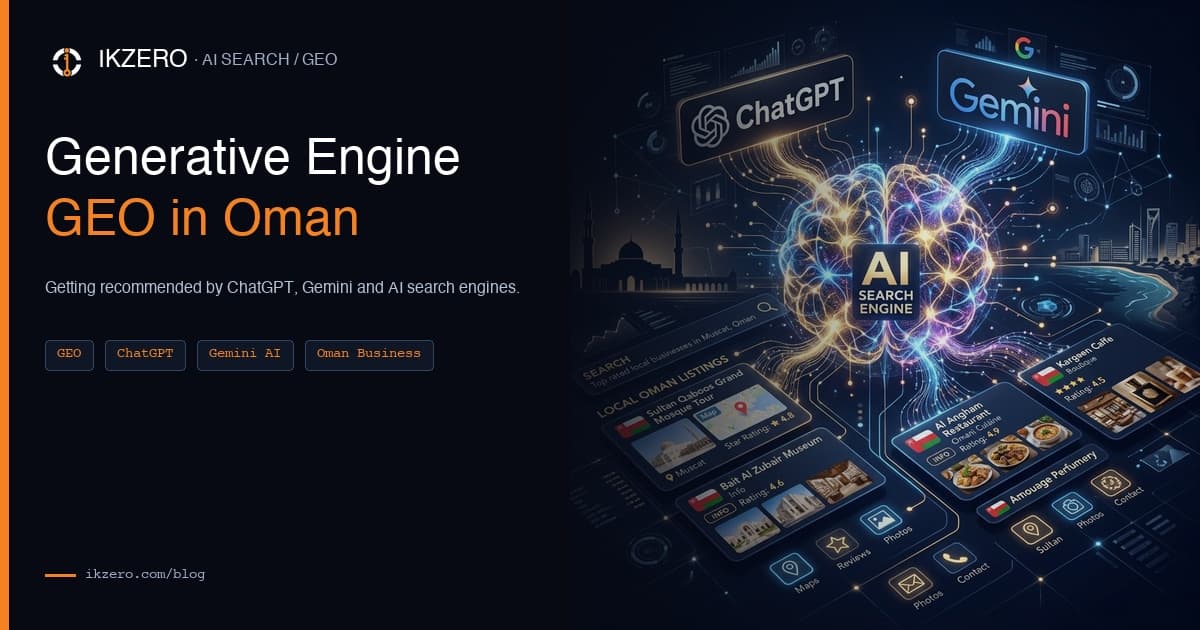
Generative engine optimization (GEO) is the practice of preparing your website so AI assistants like ChatGPT, Gemini and Perplexity recommend and name your business when a customer asks them a question. In plain terms: when someone in Muscat asks an AI chatbot "best accountant near me" or "reliable car service in Sohar" instead of Googling it, GEO decides whether your business shows up in the answer. It is the newest, fastest-growing part of getting found online in 2026, and most Omani businesses have not touched it yet, which is exactly why it is an opportunity for you.
What is generative engine optimization?
Generative engine optimization is optimising your online content so that AI answer engines read it, quote it, and credit your business when they generate a reply. Traditional search shows a list of blue links and lets the customer pick. AI search does the picking for them: it reads dozens of sources, chooses a handful, and writes one confident answer, often naming just a small number of businesses.
GEO is about earning a place among those few named sources. If your business is the one the AI mentions, you win the customer before your competitors are even in the conversation.
Why does GEO matter for Omani businesses now?
Because the way people search is changing fast, and Oman is right in the middle of that shift. The Ministry of Transport, Communications and Information Technology reports that the core digital economy contributed around OMR 800 million in 2023, and under Oman Vision 2040 the plan is to raise the digital economy's share of GDP from 2% to 10% by 2040. The government has also launched a National Programme for Artificial Intelligence and Advanced Digital Technologies running to the end of 2026 and an AI zone in Muscat's Wilayat of Seeb.
On the ground, that means your customers are already comfortable asking AI tools for recommendations. When someone asks an assistant "where can I get a website built in Oman?" or "which bakery in Salalah delivers?", the AI answers instantly, and the businesses it names get the enquiry. If your website is not written in a way AI can understand and trust, you are invisible in that answer, no matter how well you rank on Google.
How do AI answer engines choose which businesses to name?
AI engines do not rank pages the way Google traditionally does. They retrieve, evaluate and synthesise. Understanding that changes how you should write:
- They favour clear, factual, quotable content. An AI can lift "We build professional websites in Oman from OMR 100, delivered in one to four weeks" far more easily than a vague paragraph of marketing language.
- They reward specific numbers and details. Prices in OMR, timelines, service areas, and what is included make your content easy to quote with confidence.
- They cross-check your consistency. When your name, phone number and address match across your website, Google Business Profile and local directories, the AI trusts you more.
- They value being mentioned elsewhere. When other credible Omani sites, listings or articles reference your business, AI engines treat that as a signal that you are real.
One striking finding: an Ahrefs study of more than 3,000 common search terms found that only about 10% of the pages ChatGPT cited also appeared in Google's top 10 results. The other 90% came from pages that do not sit on Google's first page. So a business that never cracked Google's first page can still be the one an AI recommends, if the content is built for it.
How is GEO different from traditional SEO?
Think of them as two doors into the same house. SEO earns you a ranked spot on a results page; GEO earns you a mention inside an AI-written answer. SEO optimises for a click; GEO optimises to be the source the AI quotes. The good news is that they overlap heavily, so strong foundations serve both.
| Traditional SEO | Generative engine optimization | |
|---|---|---|
| Goal | Rank in Google's blue links | Get named in AI answers |
| Customer action | Clicks your link, then browses | Reads the AI's answer, then contacts you |
| Wins on | Keywords, backlinks, page speed | Clear facts, quotable text, structured data, consistency |
| Best for | People who scroll results | People who ask AI and act on the answer |
You do not choose one over the other. A fast, well-structured professional website that ranks on Google is also the easiest kind for AI to read and quote. GEO builds on top of good SEO; it does not replace it.
Practical GEO steps for your Oman business
Here is the plain, do-this-next checklist. None of it needs a big budget: it needs clarity and consistency.
- Answer real questions directly. Write the exact questions your customers ask, then answer each one in the first sentence. "How much does a website cost in Oman?" should be followed immediately by a clear, factual answer. AI engines reward content that answers cleanly.
- State concrete facts and numbers. Prices in OMR, timelines, service areas (Muscat, Sohar, Salalah and across Oman), and exactly what is included. Specifics get quoted; vagueness gets skipped.
- Add structured data (schema). This is code behind your pages that tells AI and search engines what your business is, where it operates, your hours, your services and your reviews. It is one of the highest-leverage GEO moves, and a good developer sets it up for you.
- Write a strong FAQ section. A clear frequently-asked-questions block is practically built for AI to lift. Answer each question in two to four honest sentences.
- Keep your details accurate and current. Update prices, hours and offerings. AI engines discount stale or contradictory information, so an out-of-date site actively works against you.
- Be consistent everywhere. Your business name, phone, WhatsApp and address should match exactly across your site, Google Business Profile and Omani directories. Mismatches make AI unsure which "you" is the real one.
- Earn mentions across the web. Get listed in reputable directories, featured in local write-ups, and referenced by partners. Each credible mention tells AI that you exist and matter.
- Publish in Arabic as well as English. Many Omani customers ask AI in Arabic. Bilingual content widens the range of questions you can be the answer to, across Oman and the wider GCC.
Do these well and you are optimising for AI search and traditional Google at the same time: the same clarity serves both.
Does GEO replace SEO, or work alongside it?
It works alongside it, and the two reinforce each other. Every GEO habit (clear structure, honest facts, fast pages, consistent listings, a solid FAQ) also strengthens your normal Google ranking. What is changing is where the customer meets you: increasingly inside an AI answer rather than a list of links. The Omani businesses that win over the next few years will be the ones that show up in both places.
If your current website is thin, slow, or written in vague marketing language, no amount of GEO tactics will save it, because there is nothing solid for the AI to quote. The foundation is a clear, fast, well-structured site. That is exactly what we build: see our approach to web design and our full web development services, all made to be found by real customers and by the AI tools those customers now trust.
Frequently Asked Questions
What is generative engine optimization in simple terms?
Generative engine optimization (GEO) is making your website easy for AI assistants like ChatGPT, Gemini and Perplexity to read, trust and recommend. When a customer asks an AI a question, GEO is what helps your business appear in the answer instead of a competitor's. In short, it is SEO for the age of AI search.
Is GEO relevant for small businesses in Oman?
Yes, arguably more than for large brands. Omani customers are increasingly asking AI tools for local recommendations, and most small businesses here have not optimised for it yet, so the field is wide open. A clear, well-structured site in Arabic and English can put a small Muscat, Sohar or Salalah business directly into AI answers at very low cost.
How is GEO different from SEO?
SEO aims to rank your page in Google's list of links so a customer clicks it. GEO aims to get your business named inside an AI-written answer so the customer contacts you directly. They overlap heavily and share the same foundations (clear content, fast pages and consistent listings), so the smart move is to do both together rather than choose.
How do I get my business recommended by ChatGPT and Gemini?
Publish clear, factual, quotable content that answers real customer questions directly, add structured data (schema) to your pages, keep your prices and details current, and make sure your business name, phone and address match everywhere online. Then earn mentions on reputable directories and local Omani sites. Consistency and clarity are what make AI engines trust and name you.
Do I need a new website for GEO, or can I optimise my current one?
You can often optimise an existing site if it is already fast, clear and well-built: by tightening your copy, adding an FAQ, and setting up schema. But if your current site is slow, vague or outdated, AI has nothing solid to quote, and a rebuild pays for itself. A quick professional review will tell you which path fits your business.
Ready to become the business AI recommends? Get a free quote for a professional website built to be found by customers and by AI search alike: clear, fast, bilingual, and made for the way Oman searches in 2026.